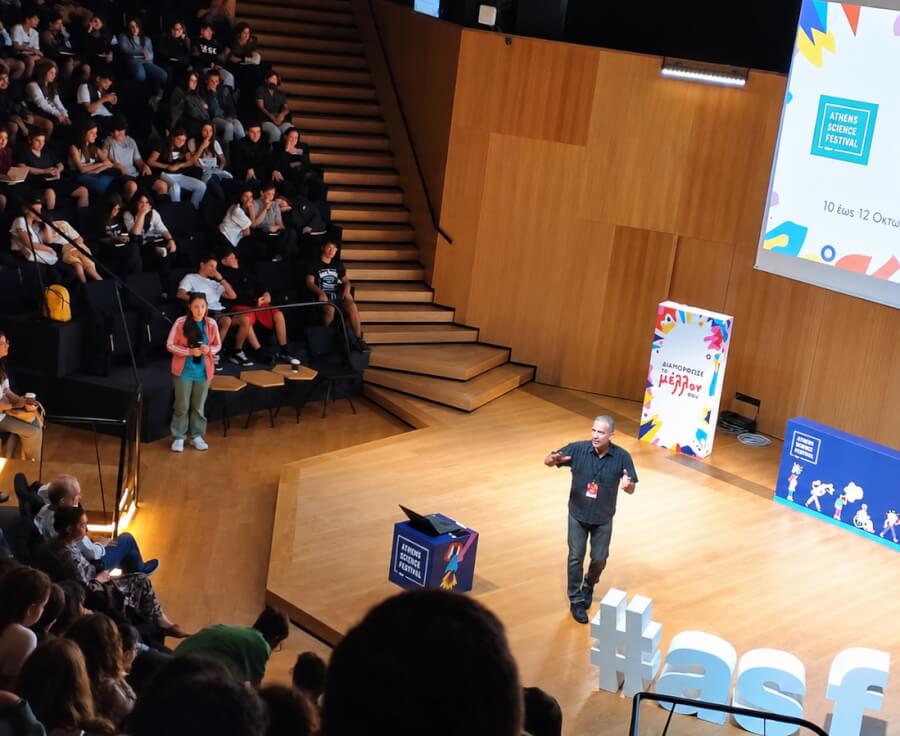
Alkis Gounaris at Athens Science Festival 2023
On October 12, 2023, at Technopolis in Athens, Alkis Gounaris delivered a talk at Athens Science Festival 2023 entitled Will Artificial Intelligence Take Our Jobs? Taking the festival's theme, Shape Your Future, as his starting point, he examined how technological change affects career decisions and the professional prospects of younger generations.
The talk opened with a familiar childhood question: "What do you want to be when you grow up?" Desire, hard work, and dedication, Gounaris argued, are necessary but not always sufficient conditions for professional success. External circumstances also matter, and technological developments are among the most decisive. They can radically reshape occupations or make some of them obsolete, regardless of individual aspirations.
Looking back at earlier technological revolutions, he discussed occupations that had been transformed or displaced, from carriage drivers to photographic-film technicians. He then identified a crucial difference. Whereas previous technological transformations had primarily replaced or augmented human physical capacities, Artificial Intelligence increasingly performs tasks associated with intellectual abilities. Drawing on Hans Moravec's image of a rising "flood" of AI, he illustrated how machines have progressively entered areas ranging from calculation and chess to creative activities and scientific research.
The question, therefore, is not simply whether "AI will take our jobs", but which tasks and occupations it may transform, to what extent, and over what timescale. As he noted, a vague question invites equally sweeping answers. Drawing on the historical example of the Luddites, he contrasted fears of technological displacement with the opposite extreme of technological optimism. Both positions, he suggested, deserve critical scrutiny rather than unqualified acceptance.
In his concluding remarks, Gounaris emphasized that AI will bring new opportunities while weakening or replacing some existing forms of work. Predicting exactly which occupations will be affected remains difficult. What matters for those planning their futures is learning to make informed choices and to use emerging technologies effectively.
He also discussed mixed human–machine teams, drawing on chess as an example of productive collaboration. The ability to work alongside intelligent systems, rather than simply competing with them, may become an important professional advantage. Ultimately, the challenge is not to resist technological development but to guide and use it in ways that improve human lives and expand human possibilities.
Read full text in Greek